Amendment VC315, gazetted on 24 September 2026, amended six of the nine sub-clauses of Clause 52.37 Canopy Trees and the tree canopy standards in Clauses 54, 55 and 57. A canopy tree is now defined by height and average canopy diameter alone, canopy cover is a percentage of site area with written counting rules, deep soil scales with the mature canopy, and the standards add a 4 metre trunk-to-building test that the clause itself does not have.
The department's explanatory report says the amendment "does not introduce new planning controls or permit requirements". That is true of the trigger and wrong in effect: more trees now meet the definition, and the same tree can need a permit under the clause while counting for nothing under the standard.
When it took effect, and which applications it catches
VC315 was approved under the Minister's intervention power in section 20(4) of the Planning and Environment Act 1987, so there was no exhibition, no submissions and no panel hearing. The Minister's reasons, signed 17 September 2026, state that those steps "will delay the updates". Councils were given notice under section 4K; third parties were not. The approved tree canopy provisions are the same as the draft prepared in July 2026.
The transitional rule is the last paragraph of Clause 52.37-9. The clause as it stood before VC315 continues to apply to any permit application lodged before 24 September 2026, and to a section 72 amendment where the original application was lodged before that date. Check the lodgement date on every job before deciding which version you are working to. It is the first thing a council officer will check.
This is the most substantial change to the clause since Amendment VC289 introduced it on 15 September 2025. The sub-clauses amended are the definitions (52.37-1), the permit requirement (52.37-2), the canopy cover requirement (52.37-3), the decision guidelines (52.37-7), the exemptions (52.37-8) and the transitional provisions (52.37-9). The purpose, the decision exemptions, the notice and review exemptions and the application requirements are untouched.
The definition lost its trunk test
Under VC289 an existing canopy tree needed all three of a height over 5 metres, a trunk circumference over 0.5 metres at 1.4 metres above ground, and a canopy diameter of at least 4 metres. VC315 drops the trunk test and makes the other two "at least" rather than "more than". An existing canopy tree is now a tree with a height of at least 5 metres and an average canopy diameter of at least 4 metres, the average being the mean of the drip-line width measured in two perpendicular directions (Clause 52.37-1).
A circumference of 0.5 metres is a stem diameter of about 160 millimetres. The old test excluded tall, slender trees and multi-stemmed trees whose crown was wide enough but whose stems were small. They are inside the clause now. No new trigger was added, but the trigger reaches further.
The carve-outs in Clause 52.37-2 are unchanged. On a site with an existing dwelling, only a boundary canopy tree, one with any part of its trunk within 6 metres of the narrowest street frontage or 4.5 metres of the rear boundary, needs a permit. A tree identified for assessment in a Clause 54, 55, 57 or 58 application is dealt with in that application, unless it is a boundary canopy tree.
Canopy is now a percentage, and the counting rules are written down
The VC289 clause set a number of trees by site area for sites up to 1,000 square metres and switched to 20 per cent canopy cover above that. VC315 makes it a percentage throughout (Clause 52.37-3, Table 1): 10 per cent of site area for sites of 1,000 square metres or less, 15 per cent for more than 1,000 up to 1,500 square metres, and 20 per cent above 1,500 square metres. Where existing cover already exceeds 20 per cent, the requirement is 20 per cent plus half of the excess. The clause's own example is a 2,000 square metre site with 30 per cent existing cover, which must keep 25 per cent. Standards B2-7 and E2-6 use the same bands. Standard A2-6 for a single dwelling still counts trees: one up to 100 square metres, two above 100 to 200, three above 200 to 300.
At least one published summary gives the 15 per cent band as 1,000 to 2,000 square metres. The gazetted figure is 1,500.
An assessment now needs a canopy area for each tree and a total for the site, not a tree count, and the clause says for the first time what is in and what is out.
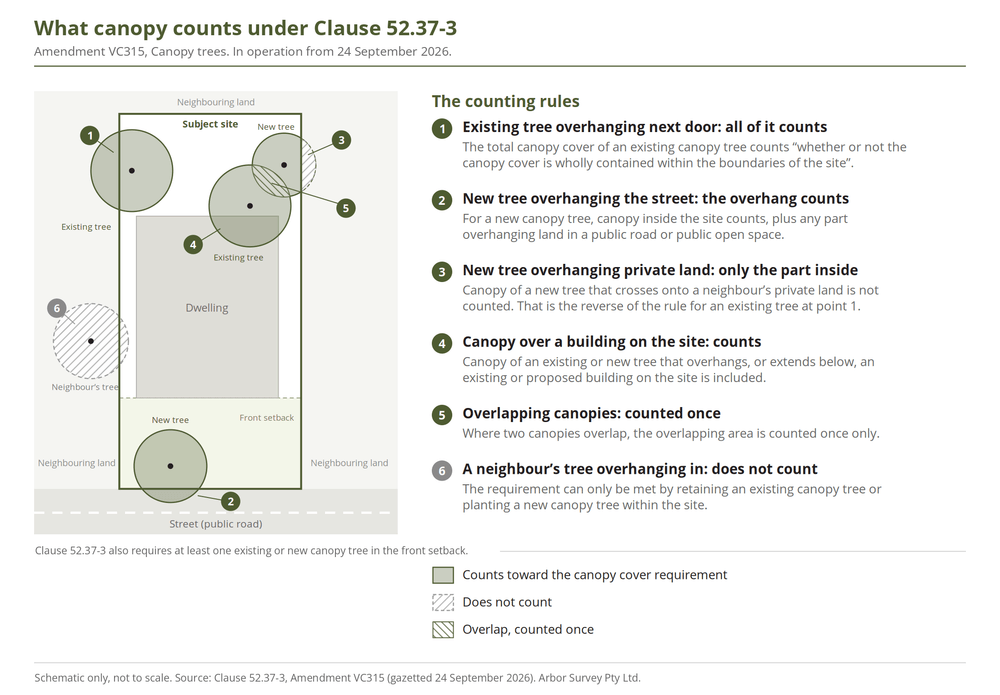
The whole canopy of an existing canopy tree counts, including the part overhanging a neighbour. For a new canopy tree, only the canopy inside the site counts, plus any part overhanging a public road or public open space. Canopy that overhangs or extends below a building on the site counts. Overlapping canopy is counted once. A neighbour's tree overhanging the site does not count, because the requirement can only be met by trees retained or planted within the site. Existing and new trees are therefore treated differently at a side boundary: an existing tree's overhang onto the neighbour counts, a new tree's does not.
At least one existing or new canopy tree must be in the front setback, unless a single retained tree outside the front setback meets the whole requirement (Clause 52.37-3, and the same wording in A2-6, B2-7 and E2-6). In B2-7 and E2-6 this replaces the previous requirement for a tree in both the front and rear setbacks, so a rear setback tree is no longer required under those two codes. The front setback tree competes with the crossover, service pits and trenches and the front fence, so it belongs on the concept plan, not the landscape plan.
Deep soil now scales with the mature canopy
The VC289 clause asked for 12 square metres of deep soil with a 2.5 metre minimum dimension, or a 12 cubic metre planter 0.8 metres deep, for every new canopy tree. VC315 replaces that with a table keyed to the species' expected canopy diameter at maturity (Clause 52.37-3, Table 2, and the equivalent tables in B2-7 and E2-6).
| Expected canopy diameter at maturity | Minimum deep soil area | Minimum planter volume and depth | Minimum plan dimension |
|---|---|---|---|
| 4 m to less than 5 m | 12 sqm | 8 m³, 0.8 m | 2.5 m |
| 6 m to less than 7 m | 25 sqm | 17 m³, 0.8 m | 3.5 m |
| 8 m to less than 9 m | 49 sqm | 30 m³, 1.0 m | 4.5 m |
| 10 m to less than 11 m | 81 sqm | 47 m³, 1.0 m | 5.5 m |
| 12 m to less than 13 m | 121 sqm | 68 m³, 1.5 m | 6.5 m |
| 14 m and greater | 144 sqm | 92 m³, 1.5 m | 7.5 m |
Selected rows from Table 2; the gazetted table has a row for every metre from 4 to 14. Where two or more new trees share one area of deep soil, the area can be reduced by 5 per cent for two trees up to 25 per cent for six or more (Table 3). Deep soil can include up to 10 per cent impervious surface, up to 50 per cent unroofed decking with minimum board gaps of 4 to 8 millimetres depending on board width and deck height, and an eave up to 600 millimetres wide. Standard A2-6 for single dwellings keeps a flat 12 square metres, and its planter volume drops from 12 to 8 cubic metres.
Clause 73.01 now defines deep soil as "soil at ground level that supports plant growth and is not encroached by a building above or below ground level". Basements and footings rule it out. Compacted fill or demolition rubble may not qualify without remediation (practitioner view, not referenced).
The consequence is that species selection sets the soil budget. A species expected to reach a 14 metre canopy needs 144 square metres of deep soil, which few infill lots can give up, so designers will reach for smaller species to fit the table. Neither the clause nor the standards say how expected canopy diameter at maturity is to be estimated, and that figure now drives both the canopy counted and the soil required, so a documented species reference will carry weight with councils and at the Tribunal.
The 4 metre test: two definitions of the same tree
Clause 52.37 defines an existing canopy tree by height and average canopy diameter. Standards A2-6, B2-7 and E2-6 add a third condition: "a trunk that is located at least 4 metres from existing and proposed buildings". Before VC315 the wording was "from proposed buildings". VC315 added "existing", which draws in every fence, outbuilding and wall already on the site.
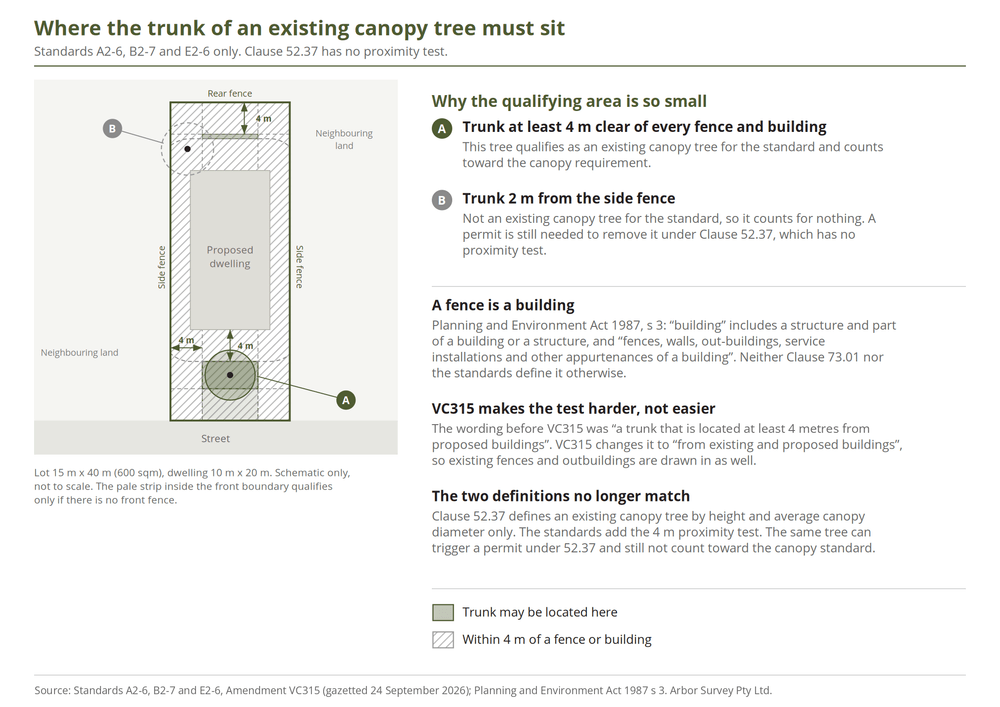
Each standard says the canopy requirement can only be met by retaining an existing canopy tree, planting a new canopy tree, or both. A retained tree whose trunk is within 4 metres of a building is not an existing canopy tree for the standard, so its canopy adds nothing, whatever its size. Clause 52.37 has no proximity test. The same tree therefore needs a permit to remove under the clause and counts for nothing under the standard. The explanatory report says the Clause 52.37 changes are consistent with the standards. On this point they are not.
Whether a fence is a building is the question that decides how much of a lot qualifies. Clause 73.01 does not define "building". Section 3 of the Planning and Environment Act 1987 defines it to include "fences, walls, out-buildings, service installations and other appurtenances of a building". On a plain reading a boundary fence triggers the 4 metre offset, which is what Figure 2 shows. Whether the Tribunal or the department will apply the Act's definition to the canopy standards has not been tested. The drafting also leaves open whether the 4 metres is measured to the centre or the face of the trunk, and whether a building proposed for demolition is still an existing building.
Failing the standard is not fatal. Under the operation provisions of Clauses 54, 55 and 57, a development that meets a standard is deemed to meet the objective, and one that does not is assessed against the decision guidelines. Those guidelines ask "whether the growth characteristics of existing trees and proposed canopy trees will provide the required canopy cover", and they say existing trees, not existing canopy trees. A retained tree that fails the 4 metre test can still be relied on in a merits assessment. What the applicant loses is deemed compliance.
A worked example. On a townhouse site assessed under Clause 55, a tree with its trunk 3 metres from the rear fence is a boundary canopy tree, so removing it needs a Clause 52.37 permit even though the development application covers the site. Keep it, and it fails the 4 metre test in B2-7 and contributes nothing to the canopy requirement, so that canopy has to come from new trees in compliant deep soil, or the applicant argues the decision guidelines.
Smaller changes worth knowing
Noxious weeds declared under the Catchment and Land Protection Act 1994 and environmental weeds determined by the responsible authority are now separate exemptions, so the reach of the weed exemption will vary between councils. Land covered by an approved precinct structure plan incorporated into the scheme is exempt from the permit requirement altogether. A new decision guideline asks about the suitability of providing deep soil within an easement (Clause 52.37-7). The July draft proposed limiting the vehicle crossover test in Standards B2-6 and E2-5 to new crossovers; the gazetted version kept the existing wording, so a crossover or accessway must not encroach more than 10 per cent into the tree protection zone of a retained street tree whether or not the crossover is new. The misspelling "exisitng" in Clause 52.37-2 survived into the gazetted clause.
What is still open
The clause does not say how to choose the two axes for average canopy diameter, or how to treat a lopsided, leaning, deciduous or recently pruned crown. It sets no method for measuring canopy area, and a circle drawn from the average diameter can overstate or understate an irregular crown. It does not say whether a new tree's canopy is counted at planting or at maturity, though the application requirements ask for the mature figure. And it sets no protection requirement for a retained tree that is being counted. The canopy is counted at approval and only delivered if the tree survives the works, which is why a counted tree should be one whose encroachment has been assessed as tolerable under AS 4970:2025 and tied to a tree protection plan with staged supervision and certification.
What this means for you
Every tree on a residential site now needs three answers: does it meet the Clause 52.37 definition, is it a boundary canopy tree, and does it meet the stricter definition in the standard. A tree schedule that records height, both canopy spreads and their average, canopy area and how it was measured, trunk distance to the narrowest street frontage and to the rear boundary, trunk distance to the nearest building, fence or wall, and the classification under both definitions lets a planner check the totals without reading the full report. Borderline trees should be reported with measured values, the instrument, the date and the leaf condition, not a bare yes or no, because many suburban trees sit close to both thresholds.
One more amendment is on the way. Proposed Amendment VC299 would extend the Clause 52.37 permit requirement to commercial, industrial and special purpose zones and give non-residential development a canopy standard for the first time. As at the date of this article it is a proposal, not an approved amendment, and the department's track-changes document for it is drafted against the VC289 clause rather than the VC315 clause now in force, so most of its red-line is VC315 content.
Sources
- Victoria Government Gazette No. S 537, 24 September 2026 (Notice of Approval, Amendment VC315).
- Victoria Planning Provisions, Clause 52.37 Canopy Trees as amended by Amendment VC315: cl. 52.37-1 (definitions), cl. 52.37-2 (permit requirement and carve-outs), cl. 52.37-3 and Tables 1 to 3 (canopy cover requirement, counting rules, front setback tree, deep soil and planter requirements, shared deep soil, permitted encroachments), cl. 52.37-7 (decision guidelines), cl. 52.37-8 (exemptions), cl. 52.37-9 (transitional provisions).
- Victoria Planning Provisions, Clauses 54.02, 55.02 and 57.02 (Standards A2-6, B2-7 and E2-6) and Clause 73.01 (definition of deep soil), track changes as approved by Amendment VC315.
- Amendment VC315 Explanatory Report, approved version; Reasons for decision to exercise power of intervention under section 20(4) of the Planning and Environment Act 1987, Amendment VC315, signed 17 September 2026.
- Victoria Planning Provisions, Clause 52.37 Canopy Trees as introduced by Amendment VC289 (15 September 2025), for the earlier definition, tree-count table and deep soil minimum.
- Planning and Environment Act 1987 (Vic), s 3, definition of "building".
- Operation provisions of Clauses 54, 55 and 57, as shown in the Amendment VC315 section 4K notice package, July 2026.
- AS 4970:2025 Protection of trees on development sites, encroachment categories (cl. 3.3).
- Proposed Amendment VC299, explanatory report and track-changes provisions, July and August 2026 (proposed, not approved, as at 15 October 2026).
Note. This article is general information, not site-specific advice.